|
Joe Watson recently caught up with
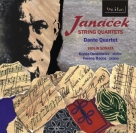
Krysia Osostowics of the Dante Quartet, and soloist on the stunning new
Meridian recording of works by Janacek, to ask her a few questions about music
and life. BUY HERE
1) What first inspired you to learn
the violin and why?
Although
I initially started playing piano, I was hooked as soon as I first heard a
violin, and it quickly became clear that it would be "my"
instrument. My Polish grandparents played folk fiddle and one of my uncles was
a keen amateur violinist, but as far as I know I am the first professional
musician in my family.
2) And who has been the most
important influence on your musical career?
My main
musical influences, in chronological order, have been:
Yehudi Menuhin, whose school I attended and whose
playing, with all its flawed beauty, was my first inspiration.
Margaret and Peter Norris, my first teachers there for violin and chamber
music, who helped me to develop a calm approach to technical challenges,
and taught me to interpret music from a starting-point of
structural and harmonic awareness.
Alberto Lysy, who forced me to play in tune.
Sandor Vegh, to whose teaching I owe
more than I can possibly describe, but whose central philosophy was not only to
sing, but to speak through music.
Radu Lupu, the great pianist with whom I have
been privileged to study much of the Sonata repertoire.
Nicolaus Harnoncourt, who re-shaped my view of Beethoven
during three intense weeks of recording all the Symphonies with the Chamber
Orchestra of Europe in 1989.
Ferenc Rados, the reclusive Hungarian pianist
who inspires musicians of all generations and nationalities with his
X-ray (or, he might say, X-rated) vision, lacerating wit and profound
musical understanding. Rados has greatly influenced my approach
to Bach, Beethoven and Bartok, both as a soloist and with the Dante
Quartet. I was astonished and delighted when he agreed to participate in this
Janacek recording.
3) What is it about Janacek – the
man and his works – that particularly compelled the Dante Quartet to record his
music?
Janacek's
musical language is extraordinarily powerful even for listeners not familiar
with any kind of "classical" music: its raw emotion and impulsive
changes of mood cut through all the barriers and reach straight to the heart of
human experience. The music presents us with many challenges: its
technical demands are extreme, and many interpretative decisions need to be
made afresh by each musician who approaches Janacek's works. But that can
only be a good thing, since it means that no two performances can be the
same.
4) Describe for us, if you
will, the experience of rehearsing, performing, and recording with such a
distinguished group of musicians.
I think all
of us would laugh to be described as distinguished musicians. Faced with Janacek's
extraordinary material, we lay into each other mercilessly in order to get
the best out of ourselves and each other, endeavouring to combine the
spirit of a live performance with the "perfection" that the recording
medium demands. Although many musicians find recording very artificial, I
like to compare it with the process of creating an oil painting, where you have
the opportunity - obviously within certain limits - to change and correct
things in order to come closer to your true vision. On this occasion the
sessions were quite intense, and we recorded all the music within three days.
5) Finally, please tell us what made
you choose to record with Meridian Records?
A mixture:
Bernard Gregor-Smith, our cellist, had previously recorded with Meridian and recommended
the company to us. Also we have a long-standing acquaintance with violinist
Suzanne Stanzeleit, Meridian's
excellent producer. We were looking for an opportunity to record the Janaceks,
even though a number of other very good versions of these works have come
out in recent years, so we were delighted when Meridian was as keen as we were to make this
recording happen.
|